


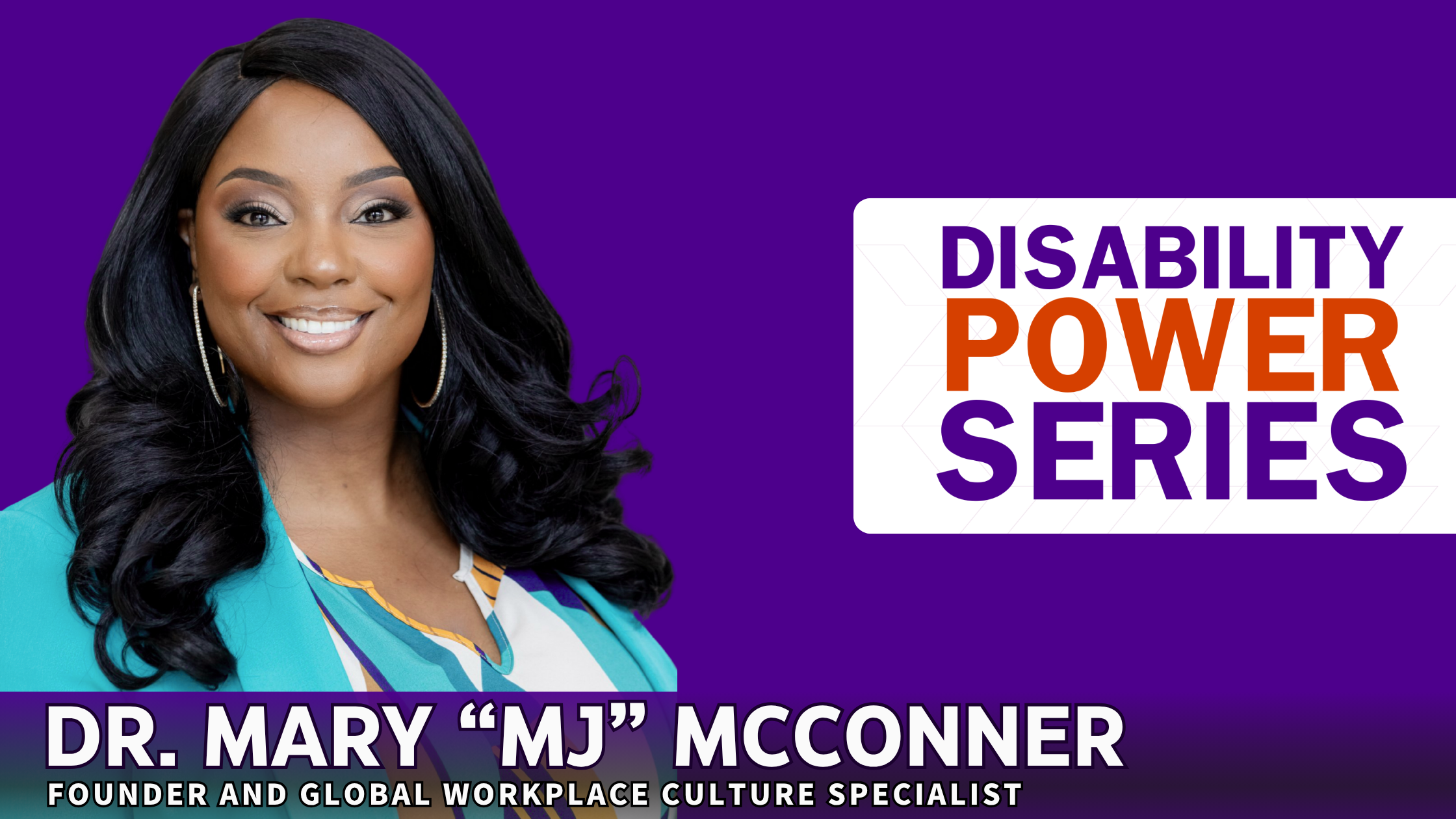
Disability Power Series featuring Dr. Mary “MJ” McConner

Transcription
Hello, and welcome to the Disability Power Series hosted byDisability Lead. Thank you for joining us for our annual celebration ofdisability leadership featuring special guest Dr. Mary “MJ” McConner.
We are so glad to have so many of our members, fellows, andfriends joining us this afternoon. I'm Clare Killy, and I'm the Education andLearning Services Manager at Disability Lead. I use she/her pronouns, and I'm awhite woman with brown and slightly gray hair, joining you from my home office.
Today's program includes ASL interpretation and CARTservices. While you can access auto captions right here in Zoom, we're alsoproviding a StreamText link in the chat where you can access CART in a separatebrowser. If you have any access issues or require assistance throughout theprogram, feel free to utilize the chat box to message DisLead Support forassistance.
This program is being recorded and will be available forpublic viewing in the coming weeks.
Disability Lead's mission is powerful in its clarity. Weincrease civic engagement and build diverse leadership by nurturing andexpanding a network of leaders with disabilities. At our core, we know thatleadership is not a privilege reserved for a select few. It is a right, and itis essential to achieving justice, equity, and inclusion for disabled peopleeverywhere.
We make connections to opportunities for our network of over250 disabled leaders, many of whom join the network by way of our year-longfellowship experience known as the Institute. The Institute is a uniqueopportunity for emerging and established disabled professionals to hone anddevelop their leadership skills among a network of passionate and dedicatedpeers.
As the manager of the Institute and a former fellow myself,it's an honor for me to get to know and learn from each of our phenomenalfellows each year. I look forward to sharing a few special videos with you atthe end of this program to announce for the first time ever our new class of2026.
But first, I'm thrilled to take a few moments to celebrateand recognize our current class of 2025 fellows as they officially completetheir fellowship and continue on as lifetime members of the Disability LeadNetwork.
To help me in acknowledging these tremendous individuals,I'd like to invite Disability Lead member and former fellow Frank Lally to joinme on screen.
Hi, everyone. Thank you, Clare. My name is Frank Lally. I goby he/him pronouns. I'm a white male with short black hair wearing a whitepolo, and I have a blurred Zoom background behind me. I work on policy atAccess Living, and I was a fellow a few years ago. Now I'm a member of theselection committee.
I’m very honored to give the shout out to the 2025 class. Ifyou'll join with me in congratulating the following folks: Allaina Humphreys,Aly Easton, Christena Gunther, Elizabeth Manderley, Elon Sloan, GuadalupePinzon, Ignacio Balcázar, Jasmine S. Deskins, Jess Grainger, Jessica Plummer,Jon Haven, Liliana Schiller, Michael Solomon, Olivia Farrell, Ryan McGraw,Sydney Barta, Tom Dreixler, and Will Corcoran.
Congratulations to the fellows from 2025. I'm really excitedto see the impact that you all will continue to make going forward.
Thank you, Frank, and congratulations again to the InstituteClass of 2025.
At this time, I'm pleased to welcome our featured guest, Dr.Mary “MJ” McConner.
Thank you so much, Clare, and before I begin, I want tothank the entire Disability Lead team. I think this is a wonderful series thatyou all are doing, and so I'm super excited to be here with you all today.
As Clare mentioned, my name is Mary “MJ” McConner. I go byMJ and I use she/her pronouns. My middle name is Joy, so MJ is the name I grewup with.
What we're going to be talking about today is a topic that Ithink is really important. We're focusing on emotional intelligence. As we havethe conversation today, I want everyone to think of emotional intelligence likea muscle, something that can be grown with time—something you can develop.
There are a lot of misconceptions about emotionalintelligence—that either you have it or you don't, or that you're either ableto connect with people or you're not. That’s simply not the case.
One thing we’ll do today is look at emotional intelligencefrom a neuro-inclusive lens. I’ll share my personal experience as someone whois dyslexic and how it is possible to build emotional intelligence.
We’ll begin with my personal story, then talk about whatemotional intelligence is, the connection between neuroinclusion and EI, andsome practical strategies and takeaways.
A little bit about my professional journey: I originallywanted to be a psychologist and earned a degree in psychology. I latertransitioned into higher education, where I eventually became a Chief DiversityOfficer.
After several years, I decided to start my own consultingfirm. It was not an easy journey. Entrepreneurship is difficult. But it hasbeen incredibly rewarding because I now work with people from all sectors:nonprofits, corporations, education, and government.
What I’ve found is that emotional intelligence transfersacross all sectors and applies outside the workplace as well.
Now I want to share something deeply personal. I want toread some of the things I heard growing up as someone who is dyslexic:
“We have to pray for your healing.”
“Hopefully she’ll grow out of it.”
“Why won’t you just read the instruction manual?”
“Kids nowadays are lazy.”
These comments were hurtful. I don’t believe all of themwere said with bad intent, but they had impact.
I also had a family member say, “Being a young Black girl inthe US is already hard enough. Don’t make it harder by being too open andhonest. Keep the dyslexic part to yourself.”
So I grew up thinking I should hide that part of myself.
That changed later in my career, largely because of mystudents. I saw young people openly embracing their accommodations andidentities without shame. That was empowering and helped me become moreconfident in who I am.
So now let's talk about emotional intelligence.
Emotional intelligence is how we manage responses, recognizeemotions in others, and communicate across differences.
It doesn’t mean suppressing emotions. It means beingthoughtful about how we respond.
It also involves seeking to understand others. Communicationbreakdowns are often at the root of conflict.
Emotional intelligence is not mind reading. It is not abouthiding emotions. It is not extroversion. And it’s not about fixing yourself.
It’s about understanding your needs and how you best showup.
There are five components of emotional intelligence:self-awareness, self-regulation, motivation, empathy, and social skills.
Self-awareness is understanding your emotions, triggers, andlimits.
Self-regulation is managing how you respond when emotions are strong.
Motivation is what drives you.
Empathy is recognizing that people communicate and express differently.
Social skills are how we navigate relationships.
From a neuroinclusive lens, we must recognize that peopleprocess differently. Some prefer to think before speaking. Others preferwriting over talking. Some need structure.
Emotional experience and emotional expression are not alwaysthe same. What we see on the outside is not always what’s happening inside.
We also need to be mindful of over-relying on nonverbalcues, because those can also vary across individuals and cultures.
The solution often comes down to communication. Clearcommunication helps reduce misunderstandings. Setting expectations, avoidingvague language, and summarizing key points help create inclusive environments.
Setting boundaries is also part of emotional intelligence.Boundaries help manage energy and create healthy interactions.
Another important aspect is recognizing differentcommunication preferences. Some people prefer phone calls, others text, othersface-to-face conversations. No single approach works for everyone.
To strengthen emotional intelligence, we can developself-awareness, regulate emotions under stress, and advocate for communicationpreferences.
Simple strategies include separating intent from impact,using “I” statements, asking clarifying questions, and summarizing what youheard.
As we close, I want you to reflect on two questions: What isone emotional habit you’d like to strengthen? What helps you feel grounded?
Your way is valid. Emotional intelligence is a skill thatcan be developed. Inclusive emotional intelligence benefits everyone.
Thank you for your time and attention.
Thank you so much, Dr. McConner. This was a very practicalsession, and I know so many folks will be able to utilize what you've shared.
At this time, we’re excited to announce our newestDisability Lead Fellows for 2026.